The Expansion Frontier
Modeling Citi Bike Network Expansion and Local Utilization in New York City
Citi Bike’s expansion across New York City did not follow a smooth, uniform pattern. Using 2022–2023 trip data, census-tract characteristics, bike-route infrastructure, and spatial adjacency, this case study examines how the network expanded geographically and how quickly newly served markets developed sustained utilization.
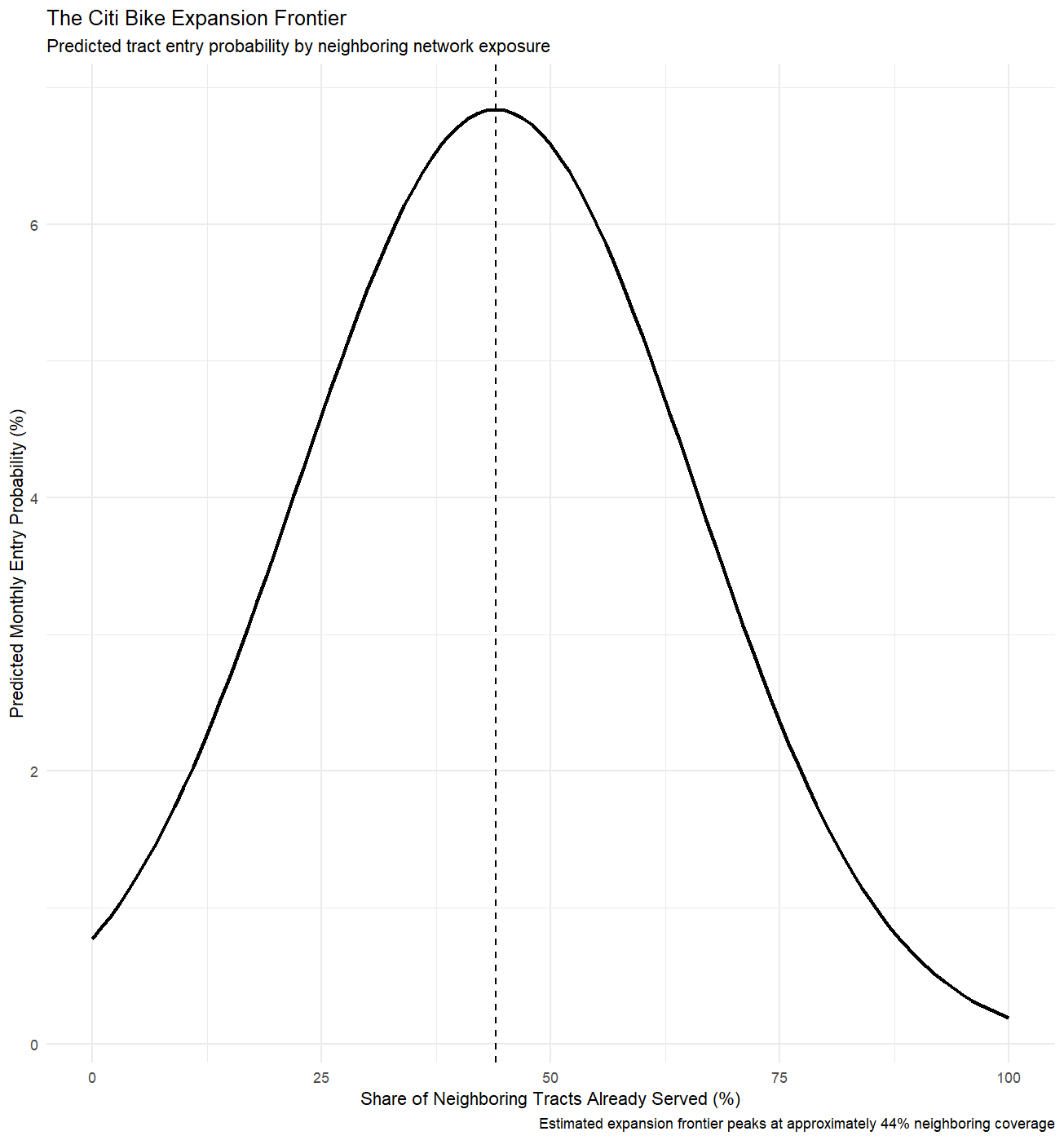
The analysis finds that Citi Bike expanded along a measurable spatial frontier. A census tract’s predicted probability of entering the network increased as nearby tracts became served, peaking when approximately 44% of neighboring tracts were already covered. Bike-route density also increased the likelihood of entry, indicating that network growth depended on both spatial proximity and supporting infrastructure.
Expansion, however, did not translate into immediate mature usage. Among newly served tracts, utilization increased rapidly after first observed Citi Bike activity and reached a modeled maturation point approximately 11.3 months later, even after accounting for seasonality, station availability, cycling infrastructure, and neighborhood characteristics.
Key Findings
667 → 904 census tracts represented in the observed Citi Bike network from January 2022 through December 2023
237 newly served tracts entered during the study period
44% neighboring coverage marked the estimated peak of the spatial expansion frontier
11.3 months was the estimated time to local utilization maturity
Greater bike-route density was associated with both network entry and stronger utilization
Why It Matters
For mobility operators and infrastructure investors, deployment and mature utilization should not be treated as the same event. A network can be physically operational while still moving through a local adoption period.
The findings suggest that expansion strategy should account for where the network frontier is located, how well new markets connect to existing infrastructure, and how long utilization may take to mature after deployment. Ignoring that lag can lead to overly aggressive near-term utilization forecasts and understated capital-carry requirements.